
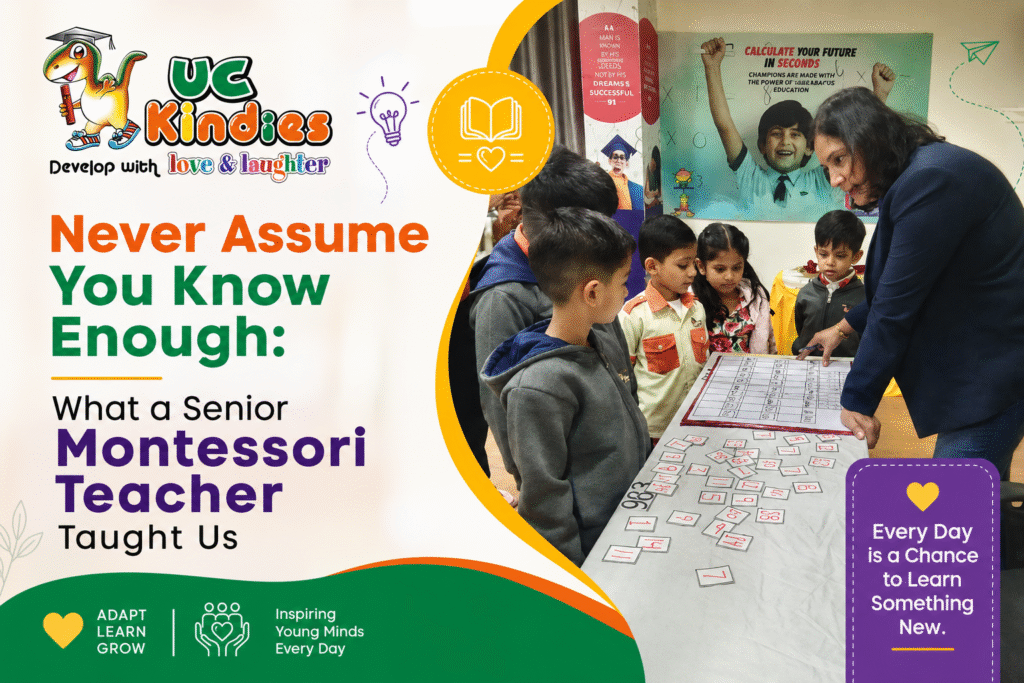
Never Assume You Know Enough: What a Senior Montessori Teacher Taught Us
When we opened our school in 2017, I already had experience teaching children. What I didn’t have — what none of us had — was experience running a playschool. Those turned out to be two very different things. We had been assuming a lot. And it took opening the school to teach us the lesson that twenty years in education should have already taught us: you can never assume you know everything. There is always more to learn, and the moment you stop learning is the moment your curriculum stops serving the children in front of you. We Tried to Learn It From Books First Once we recognized the gap, we did what most people would do — we went looking for information. We collected the right books. We searched the internet for Montessori material, downloaded PDFs, bought whatever resources we could find. It wasn’t enough. Reading about Montessori materials and methods gave us information, but not the judgment that comes from actually having used them with real children. The Real Breakthrough: Learning From Someone Who Had Lived It Eventually, my team and I found a very senior Montessori teacher and asked if we could meet with her — two hours, two or three times a week — for a fast-tracked, hands-on education. She gave us assignments. She walked us through what she had learned over years of working directly with children. I took those classes for three months. It was a complete game-changer. What she gave us wasn’t available in any book: the small, specific insights that only come from years in a classroom. What gross motor and fine motor skills actually look like in practice. How to teach phonics and alphabets to a young child in a way that actually lands. What works with little children and what simply doesn’t. What needs to be built first, before anything else can be taught. That single relationship — those few months of direct, hands-on mentorship — became the foundation for how we built our curriculum. It’s part of what you see in our classrooms today, and it’s the same knowledge we now pass on to every teacher who joins us. Breaking Activities Down to Their Simplest Form One of the most valuable things this experience taught us was how to break every activity down into its simplest possible form — a skill that, we came to realize, can really only be taught by someone who has spent years actually sitting with children in a classroom. It’s not something you can fully learn from a manual. It has to be shown to you, practiced, and corrected in real time. The Lesson We Still Carry Don’t ever underestimate the power of learning, and don’t assume that what you know is everything. There is always time to learn — and the best learning often comes from people who have quietly put in the years you haven’t. As teachers, and as founders, we try to learn something every day — not only from experienced educators, but from the children themselves, from parents, and from the experiences of others in the field. And when something in that learning suggests we should change, we change the curriculum to match it. That willingness to keep learning, and to never assume the work is finished, is what has taken us to where we are today.
Never Assume You Know Enough: What a Senior Montessori Teacher Taught Us Read More »