
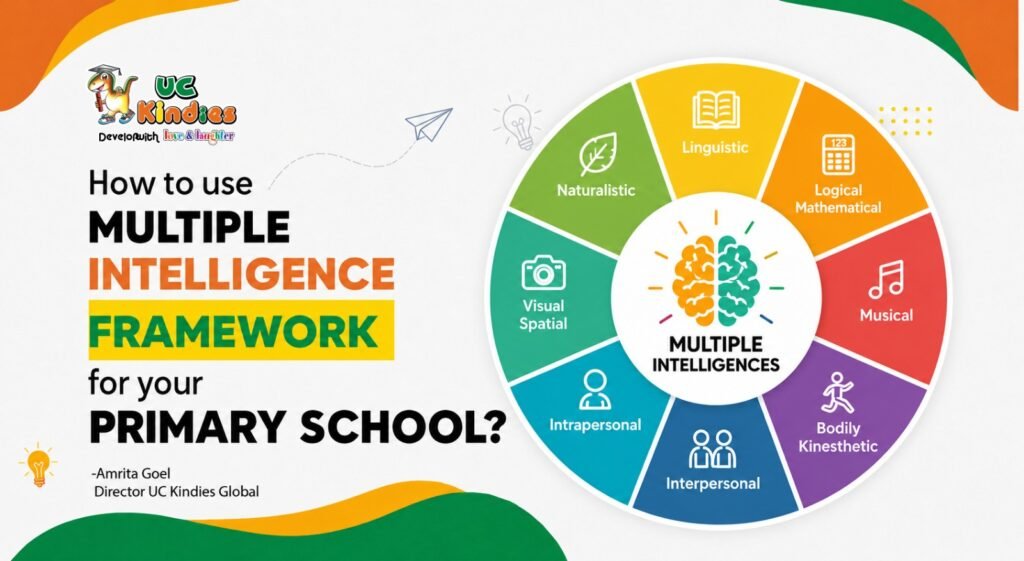
Howard Gardner in 1983 proposed the idea of multiple Intelligences. He worked on the mandate that no two children are the same. Everyone has a dominant sense that they use for learning. Some children learn by singing or with rhythm, some require movement, some need to touch and see to understand, some need to visualize, some need to interact, ask questions for clarity, some learn by imitating, some need a quiet space to learn new concepts- to put things in perspective, some need clear instructions to how to get the work done, someone’s brain is more logical, while somebody’s might be more creative and visual.
It is every teacher’s responsibility to tackle this with a well-planned out class. Over the years we found that what worked for one batch doesn’t work for another. Some classes were more interactive, some batches refused to interact and preferred instructional learning. Some loved colors, some loved games, and some developed on free play.
So, the teacher needs to understand the batch first. The first month of any primary /pre-primary class needs to be something that helps the teacher to understand the kids and vice-versa. Without assumptions- start with behavioral regulation. Taking about expected behavior in class, with peers, in groups, outside, inside as stories or role play. What constitutes respectful or disrespectful behavior? Set the boundaries early, not later. Observe what the problem areas are, talk about those- bathroom training, food, independence, peer to peer interaction, kindness, sharing….
Now after a month when it comes down to curriculum use Howard Gardener’s multiple intelligence approach. How? Let see.
Any concept that is given as a worksheet should be converted into an activity. Not on the board, but as a kinesthetic, movement related activity. For example if we have to teach alternative patterns, the worksheet shows blue, pink, blue, pink? – What comes next?
The most inefficient way would be to open the book and myme it out aloud. The child listens, the teacher guides and also gives the answer. (You won’t believe the number of classrooms I have seen this happening in)
The other method: Place pom-poms or any object in two colors in the same sequence b-p-b-p-? And ask them what comes next. Works but the child still hasn’t developed the learning.
The next method:
First-check if the colors (pink, blue) are known
Second- can they differentiate and sort colors (shows true understanding)
Third- if I show them a pattern and explain how it works (pink comes after blue, and then we place blue again, and then pink, now look at the series created. Blue-then pink, and then again its blue and then again pink, now can you continue this sequence….. And see if the child can continue (give them 10 pieces of each color- build patience and resilience).
Fourth- Give them another set of 2 colors and let them create their own. Or give them any 2 -3 articles in groups of 3 or 4 and ask them to create their own sequence and explain how it works for them. That would be a more creative, logical, kinesthetic approach to learning where you would accept that each child has their individual differences and we celebrate that.
Fifth- Make an obstacle path (they are familiar with) and have pom-poms/blocks in 4 colors placed on the table. Make 5 cards of alternating color patterns. Keep the card ready for the child. Once he crosses the path, he comes to the table and continues the pattern on the card or copies it (depending on level of understanding). Have a teacher at the table for kids who still haven’t got it yet (but only as a facilitator who helps them to think).
Every learning in a class needs to be imbibed through fun, play and creativity. A let’s bring it into our classrooms every day.
I wrap up this blog here and will come back with more insights into Primary learning.