
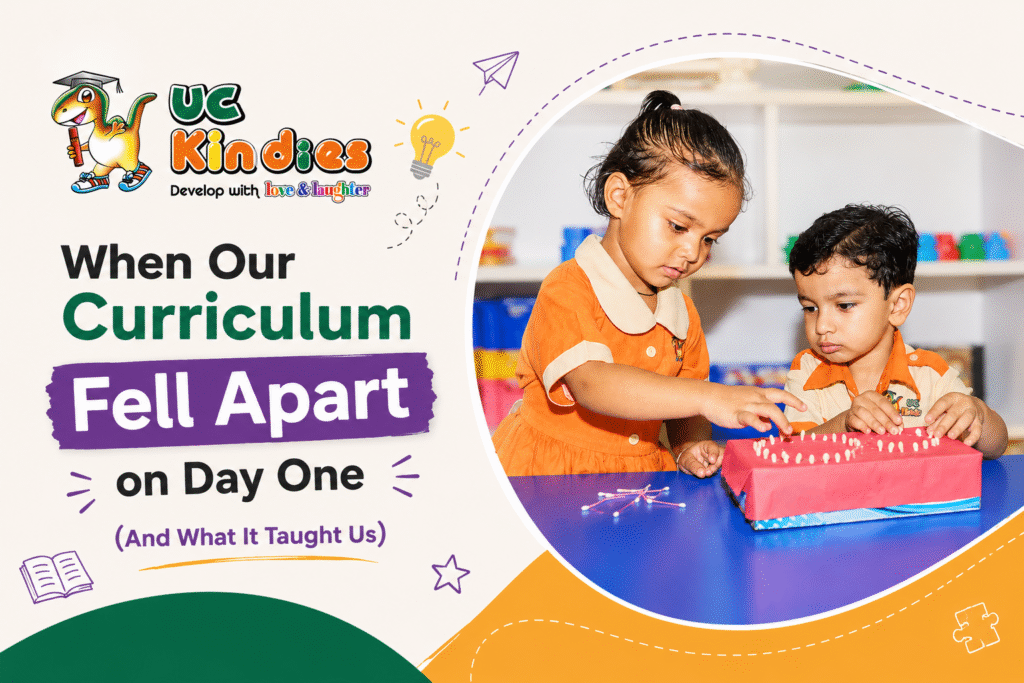
Before UC Kindies ever opened its doors, we thought we had it figured out.
We sat in our offices for months, building monthly planners for Playgroup, Nursery, Junior KG, and Senior KG — mapping every activity to the curriculum we had so carefully designed. On paper, it was thorough. It was structured. It was, we believed, ready. Then came the first of November. The children walked in. And the entire curriculum fell flat on its face.
The First Lesson: Children Cry
We had expected the kids to walk in and be quiet, composed, responsible from day one. Instead, they walked in crying.
What we hadn’t accounted for was the most basic truth of early childhood: children need time to regulate themselves. It takes fifteen days to a month for a child to settle — to control their emotions, to feel safe, to begin becoming self-independent. No planner had prepared us for that. It was only when we sat with this reality that we realized how much of our “curriculum” had been designed for an imaginary, already-adjusted child, not the real one standing in front of us on day one. That changed everything.
The Second Lesson: Skills Don’t Start Where You Think They Do
Once the curriculum was underway, another gap surfaced. We had built activities without ever mapping what skills the children already had — or didn’t have. Some skills simply had to be built from scratch.
This forced a deeper realization: every activity has to be designed around the current status of the child — their existing abilities, their capacity to learn, and specifically their fine motor development. Where those skills weren’t there yet, it was on the teachers to build them, sometimes downgrading an activity to meet the child exactly where they were.
That’s when we understood that a curriculum can’t be a flat, single-level plan. It needs stages. Every activity needs stages — a progression that moves a child grade by grade, step by step, until they reach the level of understanding we were aiming for. This single shift reshaped how we thought about curriculum design going forward.
The Third Lesson: Independence Comes Before Everything Else
The most humbling realization was around behavior and self-regulation. The children weren’t self-regulated. Many didn’t know how to use the toilet on their own. They didn’t know how to pull down their own clothes, open their own water bottles, or eat their tiffin independently.
It became clear that teaching a child to “shell peas” or “peel potatoes” — the kind of fine-motor, practical-life activities we’d proudly built into the curriculum — meant nothing if the child couldn’t yet manage the toilet, dress themselves, or feed themselves. Independence in daily living had to come first. Everything else was built on top of it.
So we restructured the course. Self-help and independence skills moved to the foundation, ahead of the more elaborate activities we’d originally planned to lead with.
What It Taught Us
Looking back, that first month wasn’t a failure of planning — it was the education we needed before we could actually educate anyone. The curriculum we started with was built in a room, based on books and theory. The curriculum we ended up with was built by watching real children struggle, cry, adjust, and grow.
That’s the version that actually worked. And in many ways, it’s still the foundation everything at UC Kindies is built on today.