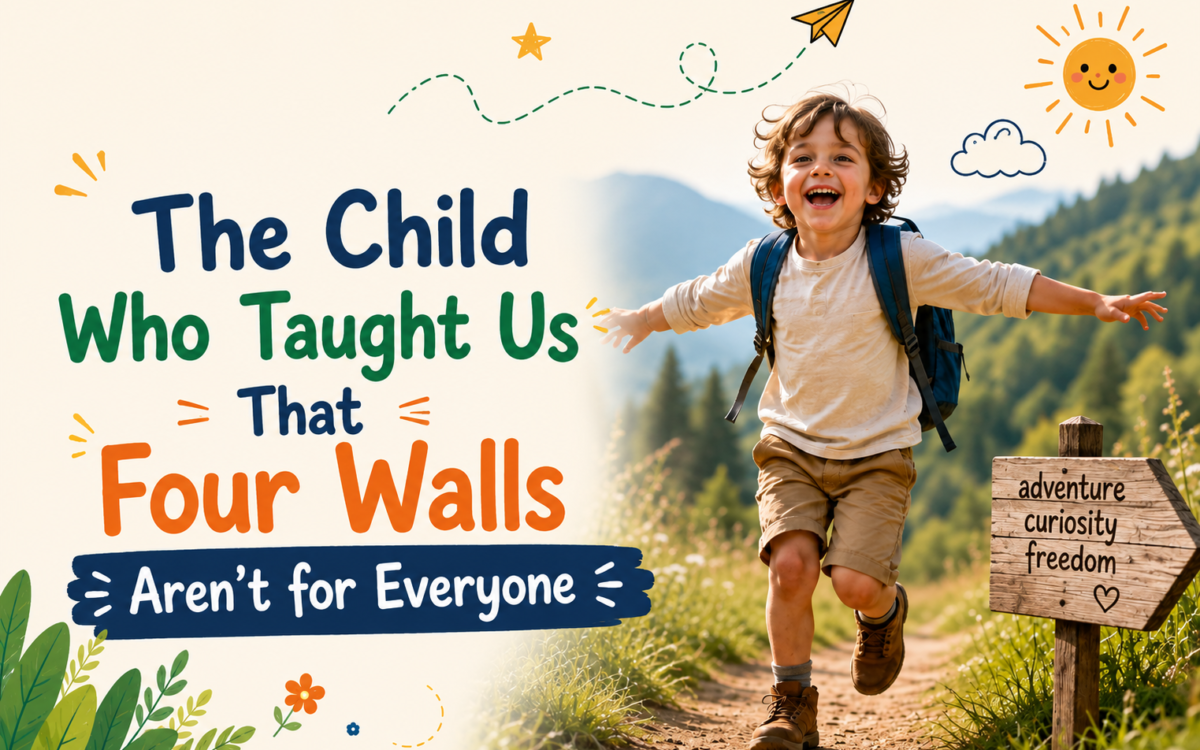
The Child Who Taught Us That Four Walls Aren’t for Everyone
Among the first three children in our school was a little boy — also a teacher’s nephew — who simply refused to listen to instructions. He threw tantrums. He was, unmistakably, unhappy. And nothing we tried seemed to reach him.
We tried discipline. We tried patience. We tried love. We tried games, new books, one-on-one conversations, and playing alongside him. Nothing worked — at least, not inside the classroom.
What Observation Revealed
It was only after quietly observing him over time that the pattern became clear: he was happier outside. The moment he stepped into the garden, his entire mood shifted. And every time we tried to bring him back inside, the tantrums returned.
That was the moment it hit us — some children simply cannot thrive within four walls. It isn’t defiance. It isn’t a behavior problem to be corrected. It’s a genuine need and this wasn’t a single student problem but this was happening across all ages and classes.
Redesigning the Day Around It
That realization reshaped how we thought about our own teaching. We understood that a classroom routine needs more movement, games, and play built into it — it needs a real, deliberate balance of indoor and outdoor time, so that children grow comfortable in both spaces rather than being confined to one classroom.
So we restructured our day. After every half-hour of academic, sit-down learning, we built a session outside the classroom — storytelling, movement or obstacle courses, gross motor games, free play, and sometimes even circle time held outdoors instead of in.
The difference wasn’t limited to that one child. We saw it across the classroom — happier faces, calmer transitions, better engagement once children were back at their desks.
Why This Wasn’t Just a Lucky Guess
Looking back, what we stumbled onto through observation lines up with what research in
early childhood development has been showing for years — but more than that, it’s something we’ve now watched play out ourselves, year after year, for the past nine years.
What experience has taught us is that cognitive development takes a genuinely positive turn when children are given real time outdoors. It ties back to something as basic as circadian rhythm — the body’s natural clock — and when that rhythm is respected, we see it reflected in cognitive growth, in social skills, in a child’s ability to self-regulate. This isn’t something we saw once, with one child. We’ve seen it consistently, across age groups, across years, in how children settle, engage, and grow.
One piece of this stands out even more clearly now, with years of watching it unfold: the value of independent, unstructured free play. Whether a child is two years old or six, when they’re given space to engage on their own — even in something as simple as a hands-on art activity — and allowed to think, explore, and make their own small decisions without an adult directing every step, something shifts. That time appears to matter as much as any structured lesson. We’ve tried, ever since, to build that principle into every part of our curriculum — not just outdoor time, but time children are trusted to lead themselves.
The Lesson
We didn’t set out to prove a theory. We were just trying to help one unhappy child. But watching him closely enough to notice what actually calmed him down taught us something that shaped our entire approach to the classroom: children aren’t a uniform group who all thrive under the same conditions. Some need the outdoors, the way others need quiet and structure — and a good curriculum has room for both.
Since we built that balance into our daily routine, we’ve seen happier children across the board — not just the one who first showed us what we were missing.
Recent Posts
2 September, 2026
What We Learned Opening Preschool Franchises Across India