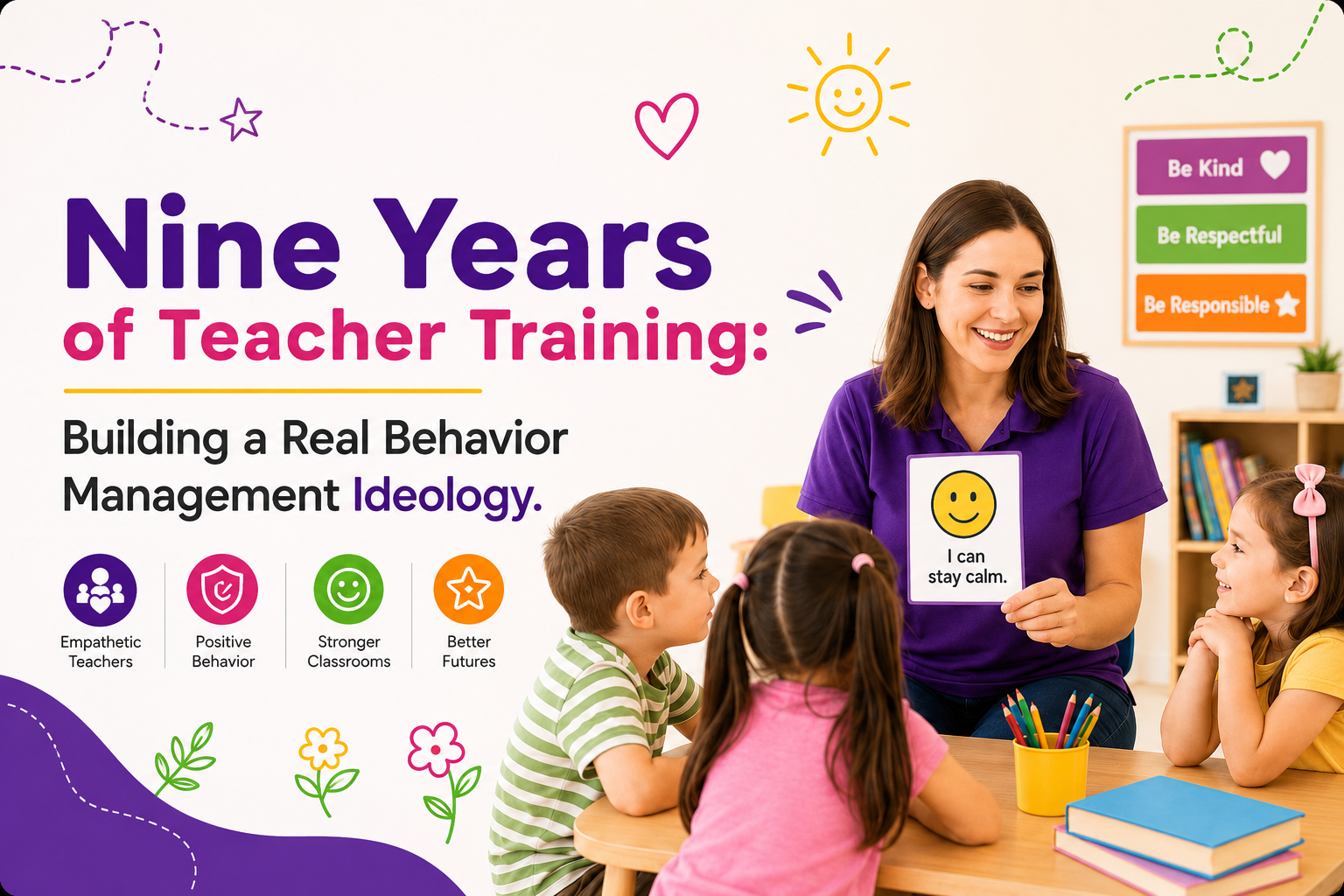
Nine Years of Teacher Training: Building a Real Behavior Management Ideology
When we started, our first real training came from a trainer who flew in from Malaysia to work with us on the basics. And by basics, we mean exactly that: the hours a class should run, the topics to be covered, a page-by-page explanation of the curriculum, and general behavioral and teacher assessments that needed to become part of how the school ran.
For the first three years, that was more or less our approach.
Learn the curriculum- Follow the pages- Assess the teachers against it.
The Shift: Behavior Comes Before Curriculum
Three years in, something became unmistakably clear: behavior took precedence over everything else.
It didn’t matter how well a teacher knew the curriculum if she couldn’t manage the behavioral tendencies of the children in front of her, or help them build self-regulation. And it didn’t matter how well-designed our activities were if teachers didn’t understand what a child goes through when they’re detached from home for the first time and placed into unfamiliar social circumstances — a room full of strangers, a routine that isn’t theirs, expectations they’ve never faced before.
That realization meant we needed an entirely new way of training. Not an update to what we already had — a different starting point altogether, to realise our dream of becoming the best outcome based Preschool in India.
Building Training Around Behavior First
We introduced a basic orientation training focused specifically on how to work with behavioral urges in children — not as an afterthought bolted onto curriculum training, but as the foundation teachers needed before they even opened the curriculum.
This took two distinct forms. One was dissection-style sessions on behavioral therapy with children — breaking down real behavioral situations and working through them the way a case would be studied, rather than simply issuing rules on classroom management. The other was a session focused entirely on the teacher herself — what she needed to have in place, understood, and settled within her own approach before she stepped into curriculum delivery at all.
Building a Complete Ideology: Behavior Management for Teachers
The behavioral shift didn’t stop at understanding the child. We realized we also needed to build an entirely new ideology around the teacher herself — what we came to call behavior management.
This covered the teacher’s own work ethic: how she accepts constructive criticism, how she communicates within the team, how she helps maintain a harmonious environment for the children around her, and how she raises concerns with management rather than letting them sit unspoken. It covered decorum — how she carries herself in class, and even in the small details, like the time she takes while leaving the school at the end of the day.
It went further into the craft of teaching itself: how she maintains a gentle but compelling tone and volume while delivering a lesson, how she thinks on her feet, how she uses questioning techniques that actually encourage children to think rather than simply respond. How she plans her lessons and does her own research. How she respects the individual differences between children rather than teaching to an imagined average child. How she conducts role plays, anticipates problems before they escalate, and redirects behavior calmly rather than reactively.
And underneath all of it sat the basic classroom management skills: inviting children into learning rather than commanding them into it, preparing lesson sheets, setting worksheets at the right level of difficulty for each child, arriving on time, giving feedback to management, and finding room to implement her own creative ideas in the classroom rather than only executing someone else’s plan.
What This Shift Really Meant
Looking back over nine years, this was the point where our training stopped being about compliance — teachers doing the right things, on the right pages, at the right hours — and started being about understanding. A teacher who understands why a child is behaving a certain way, and what that child is actually experiencing, will make better decisions in the moment than a teacher who has simply memorized a curriculum, no matter how well-designed that curriculum is.
That shift — from training teachers to follow a document, to training teachers to read a child and manage themselves with real intention — has shaped how we’ve approached every training program since.
Recent Posts
2 September, 2026
What We Learned Opening Preschool Franchises Across India