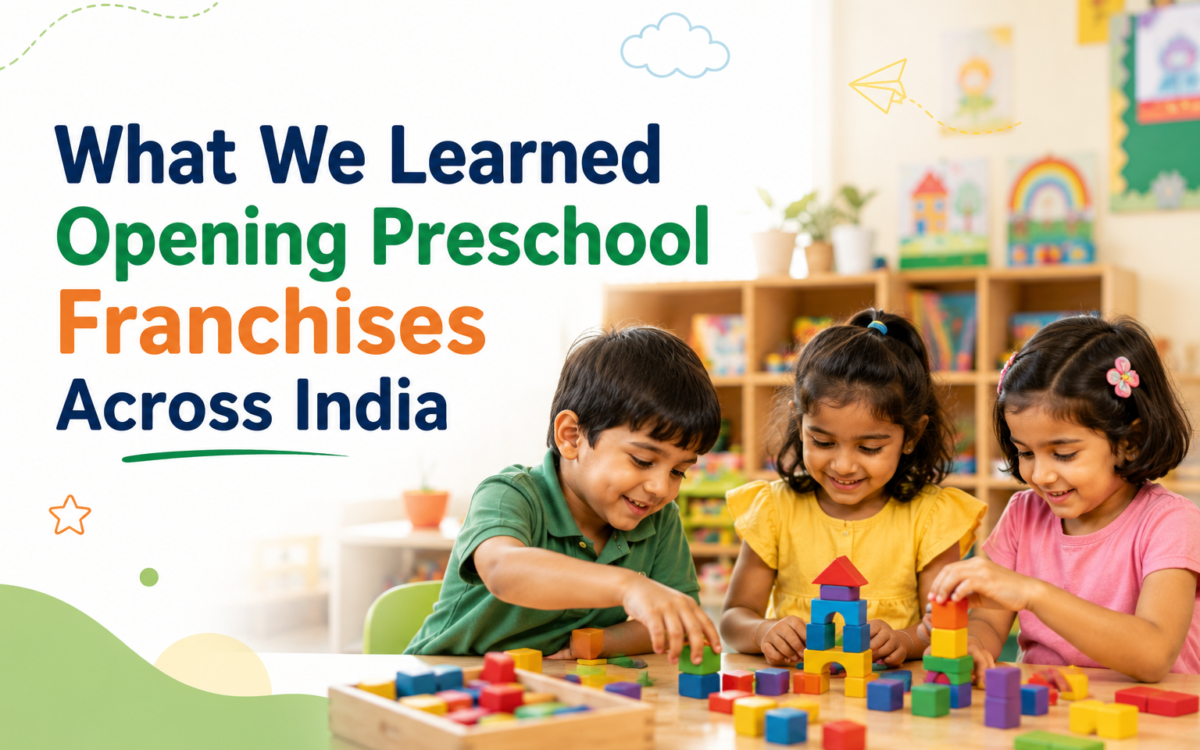
What We Learned Opening Preschool Franchises Across India
Over the years, we’ve helped open lots of franchisees across India. Along the way, certain patterns became impossible to ignore — the same mistakes, the same oversights, the same avoidable setbacks, showing up again and again in different cities. If you’re considering opening a preschool, here’s what that experience has taught us.
1. Open Space Isn’t Optional
A preschool needs room for children to play — real, open space, not just classrooms. When you’re selecting a property, look for at least 500 to 1,000 square feet of open area. A garden space with some greenery is ideal. If that’s not available, an open, uncovered space that can be converted into a play area works as a fallback. But don’t compromise on this — it’s one of the first things that shapes a child’s daily experience at school.
2. Plan for Expansion From Day One
We often see schools open with just four classrooms and stop there. But if you’re opening under a good franchise brand, growth is almost inevitable — and you’ll eventually need more space than you started with. When you’re evaluating a property, don’t just think about what you need on day one. Think about whether the property has room to expand as your school grows.
3. Budget for the Property — and for the First Year After
Look for a property in the range of thirty to sixty thousand rupees, if you’re renting the entire space. But the property cost is only part of the picture. You also need enough reserve funds to keep the school running through its first full year — because that first year is almost always slow to build.
The typical growth curve looks something like this: three to five students in the first year, building to twenty to thirty by the second year, fifty to seventy by the third, and around a hundred by the fourth or fifth year. If you don’t plan your finances around that curve, the early months can feel far more precarious than they need to.
4. Price the School to Match the Neighborhood
Your fee structure has to match the area you’re opening in. A substandard school in a high-end, expensive area will struggle — parents there have certain expectations, and if the school doesn’t meet them, it will be looked down upon. But the reverse is just as true: open a school charging a lakh to a lakh and a half a year in a solidly middle-class neighborhood, and you likely won’t get enough admissions to sustain it. Read the colony, read the area, and price accordingly.
5. If Funds Are Tight, Start Smaller — Not Slower
If your budget is limited, you don’t need to build out the entire school on day one. Start with two classrooms, and use the remaining space as activity or “fun” areas — simple labs with the basic gross motor and fine motor equipment a preschool needs. Expand into full classrooms as demand and funds allow.
C. Starting a School Is a One-Year Process — Plan Accordingly
This is probably the single most common mistake we see: franchisees who start planning too late. Opening a school properly takes about a year from the day you begin.
If you start planning in July or August, here’s roughly how the timeline plays out: finding a property and finalizing rent, handing plans to an architect or interior designer, and completing civil work — that alone typically takes two to three months. Then another couple of months goes into sourcing everything else: furniture, library books, finding the right vendors, placing and receiving orders.
By the time all of that is done, your school needs to be ready by the first week of January
— because that’s when parents genuinely start looking at schools and visiting them for admission. If your school isn’t ready by January, you will likely miss the entire March admission season. We see this happen constantly — schools that end up opening in April, having missed the admission window entirely, and then facing a long, quiet stretch through the summer holidays before the next cycle even begins.
7. Footfall Is Everything in the First Two Years
A lot of new franchisees underestimate how important simple visibility is. In your first couple of years, your priority should be increasing footfall — because if people in your community don’t know your school exists, none of the rest matters.
This means running events that pull the whole community in, not just prospective students. Involve parents, grandparents, children of different ages. Summer camps and winter camps.
Theme weeks. Animal visit days. Special experiment days. Free community health checkup camps. Celebrating festivals — Diwali melas, Rakhi melas — and sponsoring local events.
These events give people a reason to walk into your school for free, meet the teachers and the principal, and get a real feel for the place before they ever consider admission. It’s one of the most effective ways to build trust and awareness in a new location — but it does require budgeting for it from the start, so it shouldn’t be an afterthought.
The Bigger Picture
None of these seven points work in isolation — space, budget, pricing, timeline, and visibility all pull in the same direction: building a school that’s genuinely ready for the community it’s opening in, on a timeline the admission cycle actually rewards. Skipping even one of them tends to show up later as a problem that’s far harder to fix than it would have been to plan for.
Recent Posts
2 September, 2026
What We Learned Opening Preschool Franchises Across India